
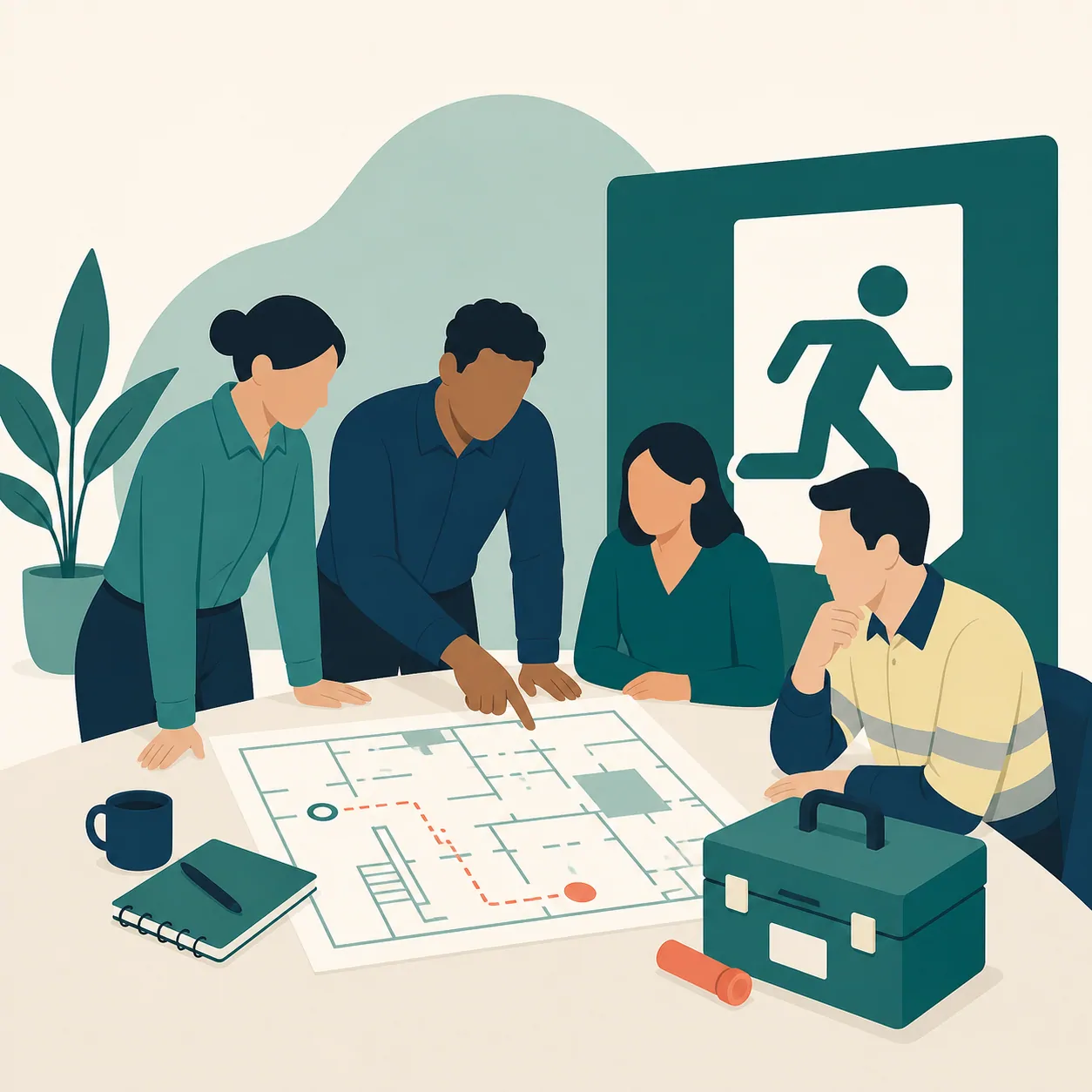

- Emergency action plan definition
- Start with realistic risks
- Put immediate actions first
- Plan the Triple Zero call
- Assign roles, with a backup
- Know your equipment and facilities
- Evacuation, shelter and communication
- Medical plans and privacy
- Train, practise and review
- A practical one-page checklist
- Related glossary terms
- Sources reviewed
Emergency action plan definition
An emergency action plan is a simple, documented plan for how people will respond when someone is seriously injured, becomes suddenly unwell, a fire starts or another emergency threatens safety. It identifies likely risks, emergency contacts, who does what, how to call Triple Zero (000), where equipment is located and how people will be guided to safety.
The point is not to create a thick binder that no one reads. A useful plan helps ordinary people make calm, quick decisions under pressure. It should be short enough to use, visible where people need it and tested before a crisis. A family, sports club, small business, workplace and community event will all need different detail, but the fundamentals are similar.
Start with realistic risks
List the events most likely to need a response in your setting. At home this may include a medical emergency, fall, fire, heat illness, poisoning or storm. At a workplace it may include a severe cut, chemical splash, vehicle incident, machinery injury, electrical hazard, violence, fire or evacuation. At a sporting event it may include concussion, sudden collapse, severe bleeding, heat illness, allergic reaction or a missing child.
Do not try to write a plan for every imaginable event on the first day. Begin with the risks that could cause serious harm and the situations that have happened before or nearly happened. Check the building, activity, location, people involved, travel time for emergency services and the equipment available.
Use a risk assessment to decide what needs prevention first. An emergency plan is not a substitute for removing hazards, maintaining equipment, safe work systems or suitable supervision. It is the response layer when prevention has not been enough.
Put immediate actions first
Every plan should open with a brief emergency sequence. For example:
- Make the area safe if possible.
- Check the person and call Triple Zero (000) for a serious or life-threatening emergency.
- Send someone for the first-aid kit, AED or other needed equipment.
- Give first aid within your training and follow emergency-operator instructions.
- Send someone to meet and guide responders.
- Record the incident and review the response afterwards.
This is not a replacement for training. It is a memory aid. Keep the language plain and avoid jargon. Anyone reading it should know the first thing to do without turning through several pages.
Plan the Triple Zero call
Write the exact street address, building name, unit, entrance, floor, gate instructions and nearby landmarks on the plan. In a rural or outdoor location, add road access, property name, coordinates, trailhead, field entrance or the nearest reliable landmark. Do not assume a phone location will always be enough.
Nominate a person to call 000 and another, if available, to meet the ambulance, fire or police. The caller should say which service is needed, describe what happened, answer questions about breathing and consciousness, give the exact location and stay on the line. The guide should explain how to make access easy: unlock gates, clear a path, display the number and secure pets where safe.
Include non-emergency contacts separately so people do not use 000 for routine questions. In Australia, Healthdirect on 1800 022 222 can provide nurse advice for non-life-threatening health concerns. Local police, facilities and after-hours contacts may also be useful depending on your setting.
Assign roles, with a backup
In an emergency, people often stand back because they do not know whether they are allowed to act. Assign simple roles in advance: emergency caller, first aider, AED/kit runner, access guide, evacuation warden, communications lead and incident recorder. In a small household, one person may cover more than one role; in a larger workplace, have substitutes for absences and shifts.
Roles should be based on training and capability, not job title alone. The trained first aider should not be expected to leave a casualty to search for an AED. The caller should not be expected to manage crowd control while answering an operator’s questions. Give each role a simple prompt card if the group is large or response tasks are complex.
For children, visitors and people with disability, consider how they will receive instructions and who will help them. Keep plans inclusive and specific without publishing personal medical details unnecessarily.
Know your equipment and facilities
Record the location of first-aid kits, AEDs, fire extinguishers, spill kits, eyewash stations, emergency showers, exits, assembly points and emergency lighting. Mark them on a simple map. Check that the path to each item is clear and that people can reach it outside normal office hours or when a building section is closed.
First-aid equipment should match the assessed risks. A basic kit may be enough for a low-risk office; a workshop, remote worksite, school or sporting venue may need extra supplies, an AED or specialised equipment. Keep stock in date, packaging intact and staff aware of where it is. Equipment locked away without a clear access method is not a real emergency resource.
Do not add equipment that no one is trained to use simply because it looks comprehensive. Training, maintenance and a review process are as important as the item itself.
Evacuation, shelter and communication
For a fire, gas leak, threatening weather, security incident or other site hazard, the plan should identify safe exits, assembly areas, shelter locations and who accounts for people. Keep routes accessible and do not plan to use lifts in a fire unless emergency procedures specifically allow it.
Decide how you will communicate: alarms, a phone tree, radio, text group, public-address system or a nominated messenger. Include a method for people who may not hear an alarm or who need assistance moving. If the workplace has visitors or contractors, make emergency information part of sign-in or induction.
At outdoor events, account for weather, crowds, mobile reception, lighting and access for ambulances. A map that works in a boardroom may be useless in a dark car park. Walk through it at the actual location.
Medical plans and privacy
Some people have individual asthma, anaphylaxis, diabetes, seizure or other health action plans. Ask the person or parent how they want those plans stored, accessed and shared. Keep the plan with relevant emergency medication where appropriate, protect privacy and make sure responsible people know when to call for help.
Do not create a generic emergency plan that tells untrained people to diagnose or give prescription medicines. Follow the individual’s current written action plan and emergency-service instructions. Review plans before excursions, camps, sporting seasons or major events.
Train, practise and review
A plan that has never been tested will reveal gaps during a real emergency. Run short, realistic drills: can someone find the kit? Can they state the exact address? Who meets the ambulance? Can the AED be retrieved quickly? Are exit doors unlocked? Does everyone understand the assembly area?
After a drill or incident, record what worked and what did not. Update phone numbers, staff roles, site maps, equipment locations and hazards. Review at set intervals and whenever there is a significant change: new premises, new activity, new chemical, building work, a serious incident or a change in key personnel.
Keep the final plan where people can find it: on a noticeboard, in a first-aid folder, at reception, in a vehicle or in a clearly named shared folder. A digital copy is useful, but have a printed backup in case of a power or network outage.
A practical one-page checklist
An effective one-page plan includes the full address; 000 emergency instructions; key contacts; first aider and backups; first-aid kit/AED locations; exits and assembly point; evacuation roles; individual-plan storage; incident-report process; and the date of the last review. Add a simple site map if it makes access or exits clearer.
Use short sentences. During a serious incident, the best plan is the one a stressed person can understand in seconds.
Related glossary terms
Sources reviewed
- Safe Work Australia: First aid in the workplace
- Triple Zero: official emergency calling guidance
- Healthdirect: calling Triple Zero (000)
- Healthdirect: first aid basics
Reviewed against Australian first aid and emergency guidance by the First Aid Glossary Editorial Team. This article is general information and does not replace emergency services, professional medical advice or hands-on first aid training.