
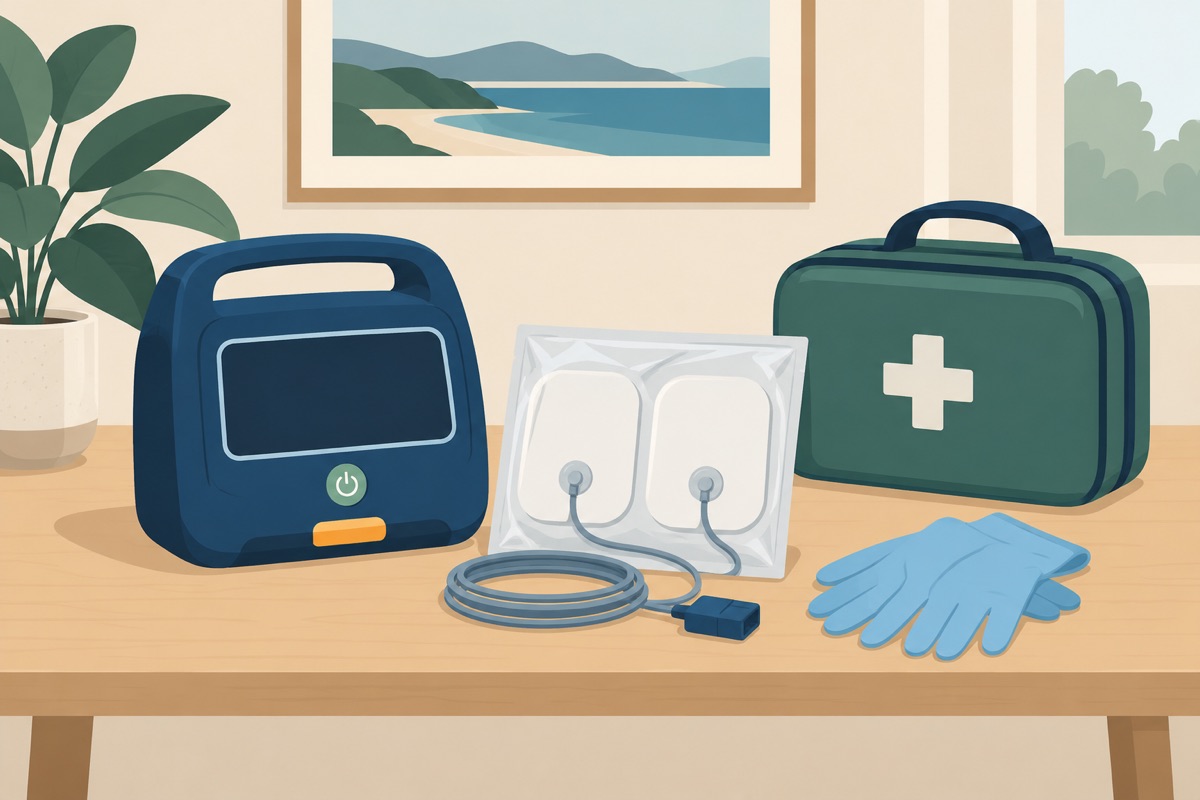

Electrode pads are the adhesive pads that connect a person to an defibrillator/" class="fag-auto-link">automated external defibrillator, or AED. They are not ordinary wound dressings. The pads let the AED read the heart’s electrical rhythm and, if the device advises a shock, deliver energy through the chest. A pair comes sealed in a packet with a cable or connector for the AED. In an emergency, the device’s pictures and spoken prompts guide the rescuer through opening the packet, attaching the pads and standing clear when required.
When are AED electrode pads used?
ANZCOR says an AED is for a person who is unresponsive and not breathing normally. Call Triple Zero (000), start CPR and have someone bring the AED. Keep chest compressions going until the AED is turned on and the pads are attached, then follow its prompts. An AED will analyse the rhythm and decide whether a shock is advised. Pads being attached does not mean a shock will always be given.
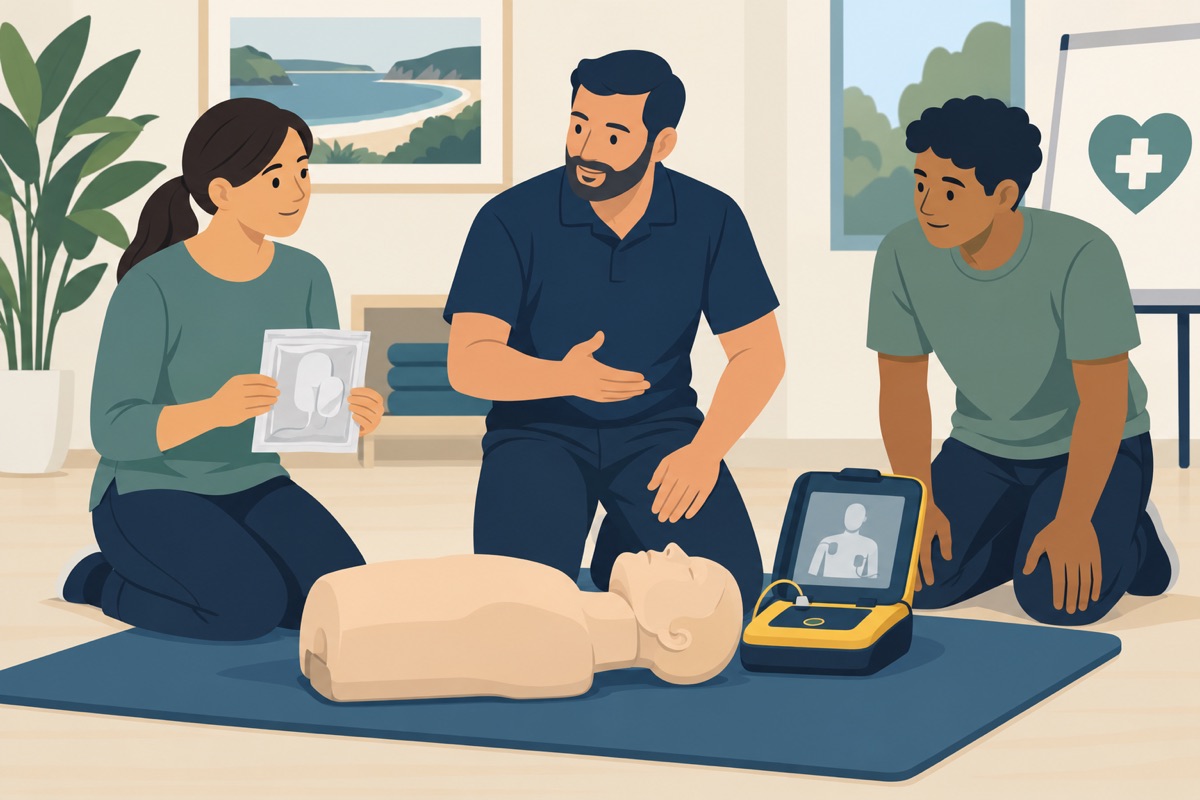
Picture a community sports club. One helper calls 000, another begins CPR, and a third opens the AED. They work as a team: the person with the AED explains when everyone needs to move clear, while the others are ready to resume compressions when the device says so. The pads create the electrical connection, but they are only one part of that response.
Where do the pads go?
Follow the diagrams on the particular pad packet and the AED’s prompts. For adults, ANZCOR describes the usual front-and-side position: one pad on the upper right chest, just below the collarbone, and the other on the left side of the chest below the armpit. The aim is for the current to travel through the heart. The chest must be exposed so the pads contact skin, not clothing. If it is wet, dry the skin quickly enough for the pads to stick; do not let preparation create a long delay.
Do not place a pad directly over an implanted device or a medication patch. ANZCOR advises placing the pad at least 8 cm from an implanted device, and removing a medication patch and wiping the area before attaching a pad. These are reasons to check the chest briefly, not reasons to abandon AED use. The operator and the AED can guide the sequence if you are unsure.
Are children’s pads different?
Ideally, children under eight years, including infants, should have an AED with paediatric capability and paediatric pads. Standard adult AEDs and pads suit children older than eight. If paediatric pads or a paediatric mode are unavailable for a younger child, ANZCOR says it is reasonable to use standard adult pads. The pads must not touch each other. If they are too large to fit apart on the chest, one may be placed on the chest and the other on the upper back, following the device instructions. This is a critical reason to practise with the actual AED model used at your workplace or club.
What does “stand clear” mean?
Do not touch the person while the AED is analysing, because movement can interfere with the rhythm check. Make sure nobody is touching the person when a shock is delivered. Say “stand clear” aloud and visually check that everyone has moved their hands away. Some AEDs deliver a shock automatically; others ask a rescuer to press a button. Follow the prompts. Once the AED tells you to resume CPR, do so without spending time trying to interpret the rhythm yourself.
What needs checking before an emergency?
A pad packet has a shelf life. St John Australia recommends regular AED checks that include the ready indicator, battery, and pads: the pads should be sealed, unused and within their expiry date. After the AED is used, replace the pads and check the battery. Match replacement pads to the AED model rather than assuming that any packet will fit. Keep the device where people can find it, and record who is responsible for checking it.
If you are looking at a packet in a kit, the practical question is not just “are pads present?” Ask whether the packet is sealed, in date and compatible with the AED beside it. An AED that cannot make good contact with the chest may give a troubleshooting prompt when every second feels long. Routine checks make that moment less likely.
What is the term to remember?
An electrode pad is the AED’s single-use adhesive contact with the person’s skin. It is different from a monitoring sticker used with other clinical equipment, and it is not a treatment on its own. For a person who is unresponsive and not breathing normally, call 000, begin CPR, attach the AED as soon as available and follow its spoken instructions.
Sources checked
- ANZCOR Guideline 7: Automated external defibrillation
- St John Australia: AED maintenance checklist
- ANZCOR Guideline 6: Compressions
Sources checked 10 October 2026. General education, not a replacement for hands-on AED and CPR training. In an Australian medical emergency, call 000.